

Complete Communities and Walkability
A Forgotten Facet of Transit-Oriented Development
A complete community is a place that provides the goods and services people need in their daily lives. It is typically defined by the proximity of amenities to where people live. Clustering amenities around a central node—such as a transit station or main street—adds convenience and efficiency, and supports higher housing densities. A central premise of this model is that people can access daily necessities on foot rather than by car. This, in turn, leads to health benefits for individuals and enhances the vitality and sustainability of neighbourhoods.
However, most complete community models overlook an important detail: the choice to walk depends not only on distance, but also on the quality of the journey. Pedestrians need to feel comfortable and safe, and walking routes should be engaging. The psychological distance of a trip is influenced by the visual experience along the way.
Over the past 18 months, the Canadian Urban Institute has developed a methodology to assess the quality of the public realm from a pedestrian perspective. This approach uses Google Street View images analyzed by a large language model (OpenAI) to evaluate intersections and midblock segments across a range of themes. Detailed prompts assess elements such as sidewalk quality, placemaking, accessibility, and the built environment. A more detailed explanation is provided at the end of this report.
This model was applied to five case study station areas. The results are presented in order from most to least walkable. An interactive map of walkability scores for each intersection and street is included below; users can click on any point to view a Street View panorama along with its corresponding assessment.
Arbutus Station Area
Vancouver
The Arbutus station area in Vancouver ranks as the most walkable among the five case study neighbourhoods. It benefits from a fine-grained, well-connected street grid linking key corridors such as West Broadway, 4th Avenue, Arbutus Street, and Burrard Street.
Construction activity at the time of analysis reduced walkability scores along portions of West Broadway. However, unaffected sections scored highly, particularly in terms of building scale and active frontages. Other main streets also perform well and offer dense clusters of amenities. Residential streets feature high-quality sidewalks and mature tree canopies that provide shade and comfort. Cycling infrastructure in the area is also of high quality, including the Arbutus Greenway, which offers strong connections to downtown Vancouver.
Overall, the Arbutus station area benefits from an existing urban form and public realm that strongly support active transportation. These qualities are likely to attract further development. The key challenge will be ensuring that new development enhances—rather than undermines—the existing pedestrian and cycling environment.
Policy implication: Existing urban form and public realm conditions strongly support walkability and intensification. Future development should prioritize maintaining and enhancing pedestrian and cycling conditions to avoid erosion of current strengths.
McKernan–Belgravia Station Area
Edmonton
The McKernan–Belgravia station area in Edmonton features walkable residential side streets, but its main corridor—114th Street NW—has a relatively poor public realm and offers few destinations beyond the transit station.
Neighbourhood streets are characterized by good-quality sidewalks and mature trees that provide ample shade. Intersections typically include painted crossings or differentiated paving (such as brick), and many have been recently upgraded with improved curbs and accessibility features.
In contrast, 114th Street NW is primarily designed for through traffic, including both vehicles and transit. It lacks amenities and is further constrained by the LRT alignment along the west side, which limits crossings and creates a barrier. A pedestrian tunnel is available at 76th Avenue NW, but major cross streets to the north and south are wide and hostile to pedestrians, often featuring multiple lanes and slip lanes.
Given these constraints, 114th Street NW has limited potential to evolve into a highly walkable main street. In contrast, 76th Avenue NW presents more opportunity. It already includes some shops and services and has parcels that could support intensification. Unlike 114th Street, it functions as a connector within the neighbourhood rather than a divider.
Policy implication: Significant structural change is required to support walkability, including the introduction of a finer-grained street network, improved building orientation, and substantial public realm investment. Future development should prioritize pedestrian-oriented design from the outset.
Northfield Station Area
Waterloo
The area surrounding Northfield Station in Waterloo is largely composed of employment lands, resulting in large blocks and a dispersed urban form that is not conducive to walking. The Conestoga Parkway presents a significant barrier to east–west pedestrian movement.
Although sidewalks are present on most streets, the wide rights-of-way create an environment that feels unsafe for pedestrians, particularly when crossing. Amenities are concentrated in car-oriented strip malls and large-format retail sites dominated by surface parking.
In some cases, such as at Weber Street and Parkside Drive, buildings are located close to the street, but their entrances and façades face inward toward parking lots, leaving blank walls along the sidewalk. Residential streets are irregular and often lack sidewalks on both sides, reducing connectivity and walkability.
One notable asset is a dedicated multi-use path along the rail corridor, which connects to the historic St. Jacobs Market approximately 2 km north of the station.
If significant residential growth occurs, introducing a finer-grained street network will be essential. Improving walkability will also require new buildings to engage the street with active frontages, along with major enhancements to the public realm. Planning efforts should prioritize the pedestrian experience from the outset.
Policy implication: Significant structural change is required to support walkability, including the introduction of a finer-grained street network, improved building orientation, and substantial public realm investment. Future development should prioritize pedestrian-oriented design from the outset.
Cooksville Station Area
Mississauga
Cooksville is currently served by a commuter rail station on the Milton Line, and the Hazel McCallion LRT is under construction (as of March 2026). A future BRT line is also planned along Dundas Street, connecting to Line 2 at Kipling Station.
Originally a village, Cooksville was incorporated into the City of Mississauga during the 20th century. Like much of the city, its development has prioritized automobile travel, often at the expense of walkability.
Although Cooksville is denser than many Mississauga neighbourhoods, its urban form remains largely auto-oriented. Wide rights-of-way and commercial properties dominated by surface parking lots limit pedestrian comfort. While amenities cluster around the intersection of Hurontario and Dundas Streets, walkability remains low.
The station area itself suffers from a poor public realm and is dominated by a large parking structure with over 2,500 spaces. Residential streets are irregular and offer limited connectivity to main streets and amenities.
However, these challenges also present opportunities. Low-density commercial sites are relatively easy to redevelop, allowing for new streets and buildings designed with pedestrians in mind. The greatest challenge will be transforming Hurontario and Dundas Streets into corridors that prioritize active transportation. Long-term success as a walkable, transit-oriented complete community will depend on this transformation.
Policy implication: Redevelopment of underutilized commercial lands presents a key opportunity to retrofit the area. However, achieving a walkable, transit-oriented community will depend on transforming major corridors—particularly Hurontario and Dundas Streets—to prioritize pedestrian movement and reduce auto dominance.
Panama Station Area
Brossard
Panama Station, part of the REM network in the Montreal region, is located in the median of Autoroute 10 near a cloverleaf interchange with Taschereau Boulevard—an environment that is highly hostile to pedestrians.
The interchange effectively divides the area into four distinct zones, each dominated by low-density commercial uses and large surface parking lots. Beyond these are conventional mid-20th-century suburban neighbourhoods.
Accessing the station on foot is challenging from all directions. Major roadways act as significant barriers, and the surrounding street network further complicates pedestrian movement. While a pedestrian and cycling underpass provides access to the south side of the highway, it connects to a minor residential street via a route that may feel isolated and unsafe.
To the north, the station is connected to a bus interchange and commuter parking lot, with streets designed primarily for vehicle traffic. Routes from eastern residential areas are indirect and require crossing wide, high-speed roads.
The public realm in surrounding residential areas is also limited. Sidewalks are often missing on minor streets, and crossings are incomplete at some intersections. The irregular street network results in longer, less direct trips to local amenities.
Although there are ambitious plans to intensify the area, significant structural challenges must be addressed to create a truly walkable complete community.
Policy implication: Achieving a walkable complete community will require addressing fundamental barriers, including highway infrastructure, street network design, and gaps in pedestrian infrastructure. While redevelopment potential exists, substantial intervention will be necessary to overcome existing structural constraints.
Methodology
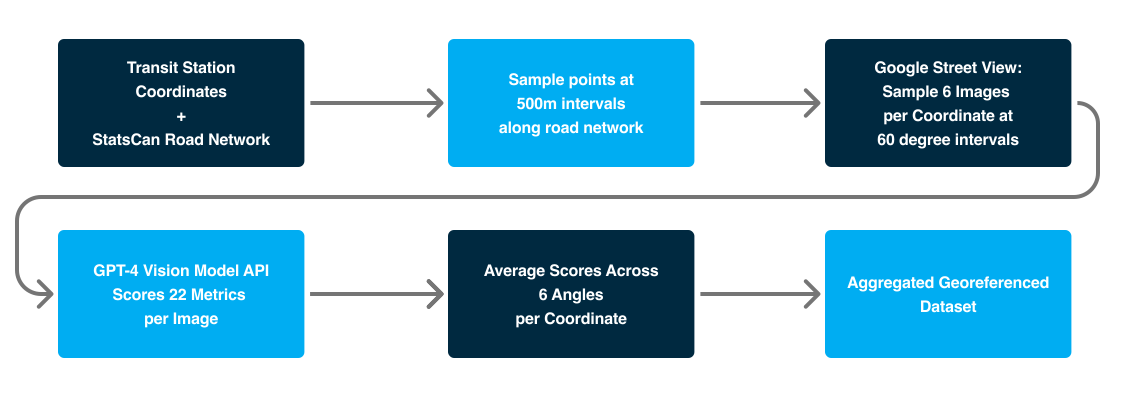
The public realm analysis leverages the Google Maps and OpenAI APIs to quantitatively assess walkability from a pedestrian-centred point of view. Images are sampled along 500m intervals on the road network surrounding a transit station area. At each coordinate, images are captured at 60 degree intervals to capture the entire 360 degree landscape at that coordinate.
Each image is then individually passed into the GPT-4o model in the OpenAI API. The multimodal vision model is primed with a prompt to analyse photos across 22 separate metrics and output a dataset capturing this analysis. The score for each metric is accompanied by a short justification, allowing for granular analysis at scale. The dataset is organised as follows:
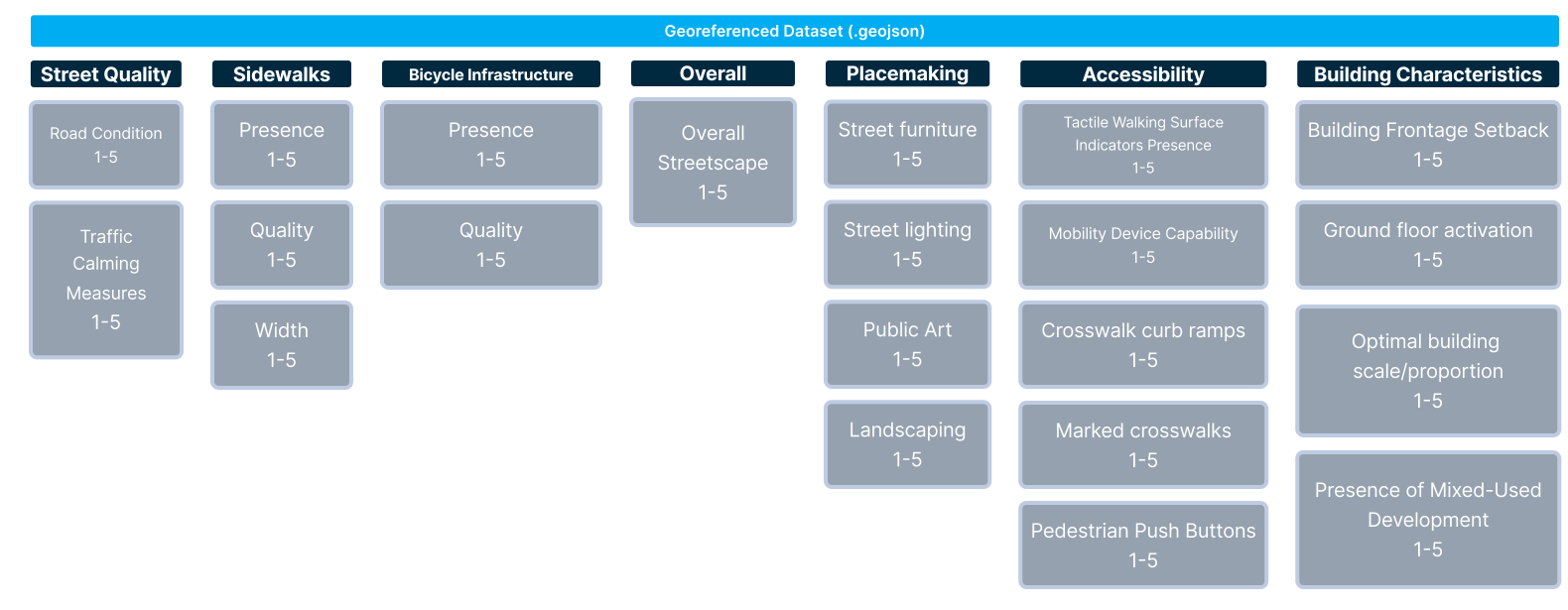
After each image is scored, the 6 datasets for each angle are aggregated together to a coordinate-level score. This is done for each coordinate captured from the road network until a dataset of scores for the entire area around a transit station is captured. Finally, the data is coloured with a gradient interpolation to show how walkability likely evolves between individual points to get a quantitatively modelled visualisation of the qualitative walkability in a given area.
Citations
- Adkins, Arlie, Jennifer Dill, Gwenn Luhr, and Margot Neal. 2012. "Unpacking Walkability: Testing the Influence of Urban Design Features on Perceptions of Walking Environment Attractiveness." Journal of Urban Design 17 (4): 499–510. https://doi.org/10.1080/13574809.2012.706365.
- Bader, Michael D. M., Sean J. Mooney, Brian Bennett, and Andrew G. Rundle. 2017. "The Promise, Practicalities, and Perils of Virtually Auditing Neighborhoods Using Google Street View." The ANNALS of the American Academy of Political and Social Science 669 (1): 18–40. https://doi.org/10.1177/0002716216681488.
- Chen, Yinglei. 2017. "How Is Built Environment Associated with the Perception of Vibrancy, Beauty, and Safety?" Paper presented at the Annual Conference of the Association of Collegiate Schools of Planning, Denver, CO.
- Clarke, Philippa, Jennifer Ailshire, Robert Melendez, Michael Bader, and Jeffrey Morenoff. 2010. "Using Google Earth to Conduct a Neighborhood Audit: Reliability of a Virtual Audit Instrument." Health & Place 16 (6): 1224–1229. https://doi.org/10.1016/j.healthplace.2010.08.007.
- Dubey, Abhimanyu, Nikhil Naik, Devi Parikh, Ramesh Raskar, and César A. Hidalgo. 2016. "Deep Learning the City: Quantifying Urban Perception at a Global Scale." In Computer Vision – ECCV 2016, edited by Bastian Leibe, Jiri Matas, Nicu Sebe, and Max Welling, 196–212. Lecture Notes in Computer Science 9905. Cham: Springer. https://doi.org/10.1007/978-3-319-46448-0_12.
- Duncan, Dustin T., Jarvis Aldstadt, John Whalen, Steven J. Melly, and Steven L. Gortmaker. 2011. "Validation of Walk Score® for Estimating Neighborhood Walkability: An Analysis of Four US Metropolitan Areas." International Journal of Environmental Research and Public Health 8 (11): 4160–4179. https://doi.org/10.3390/ijerph8114160.
- Ewing, Reid, and Otto Clemente. 2013. Measuring Urban Design: Metrics for Livable Places. Washington, DC: Island Press.
- Ewing, Reid, and Susan Handy. 2009. "Measuring the Unmeasurable: Urban Design Qualities Related to Walkability." Journal of Urban Design 14 (1): 65–84. https://doi.org/10.1080/13574800802451155.
- Griew, Paul, Melvyn Hillsdon, Charlie Foster, Emma Coombes, Andy Jones, and Paul Wilkinson. 2013. "Developing and Testing a Street Audit Tool Using Google Street View to Measure Environmental Supportiveness for Physical Activity." International Journal of Behavioral Nutrition and Physical Activity 10 (1): 103. https://doi.org/10.1186/1479-5868-10-103.
- Koo, Bon Woo, Subhrajit Guhathakurta, and Nisha Botchwey. 2022a. "Development and Validation of Automated Microscale Walkability Audit Method." Health and Place 73: Article 102733. https://doi.org/10.1016/j.healthplace.2021.102733.
- Koo, Bon Woo, Subhrajit Guhathakurta, and Nisha Botchwey. 2022b. "How Are Neighborhood and Street-Level Walkability Factors Associated with Walking Behaviors? A Big Data Approach Using Street View Images." Environment and Behavior 54 (1): 211–241. https://doi.org/10.1177/00139165211014609.
- Walk Score. n.d. "Walk Score Methodology." Accessed May 8, 2025. https://www.walkscore.com/methodology.html
Special thanks to Bon Woo Koo for his assistance with this project.