

HIGH POTENTIAL
Exploring Housing Development Potential in Transit Station Areas
KEY TAKEAWAYS
Transit investments spark housing construction,
but not all the same way in all the same places.
Growth pressure and land availability are negatively correlated
Stations with high growth pressure generally have low land availability, and vice versa.
When planning for new transit stations,
areas with high land availability and high growth pressure are key areas with high potential for housing development.
Maximizing the impact of transit-oriented development
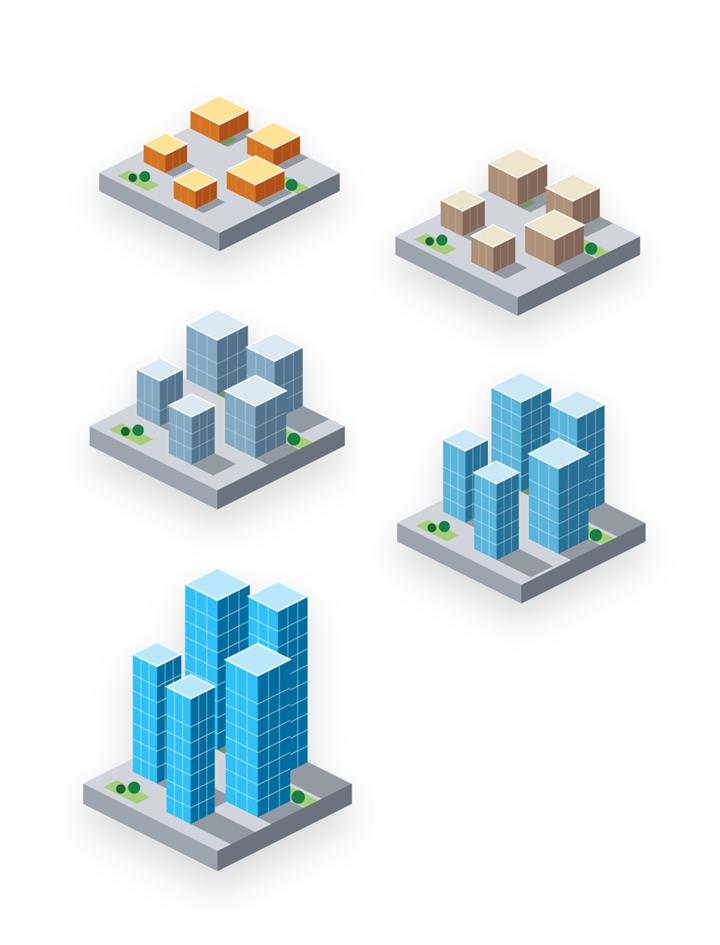
Transit-oriented housing development looks different in different places.
Transit investments spark housing construction, but not all the same way in all the same places. Demand for transit-oriented development varies from region to region, city to city, and even station to station across transit lines. When new transit stations are planned, they may be placed where demand is greatest, in densely populated urban centres, or where land supply is high, with stations planned in conjunction with new transit-oriented communities.
However, new transit stations do not universally guarantee a return on housing: new home construction in the three largest urban regions (Toronto, Montreal, Vancouver) mostly occurs close to major transit stations, while new homes in the next three largest regions (Calgary, Edmonton, Ottawa) are built mostly outside of transit station areas.
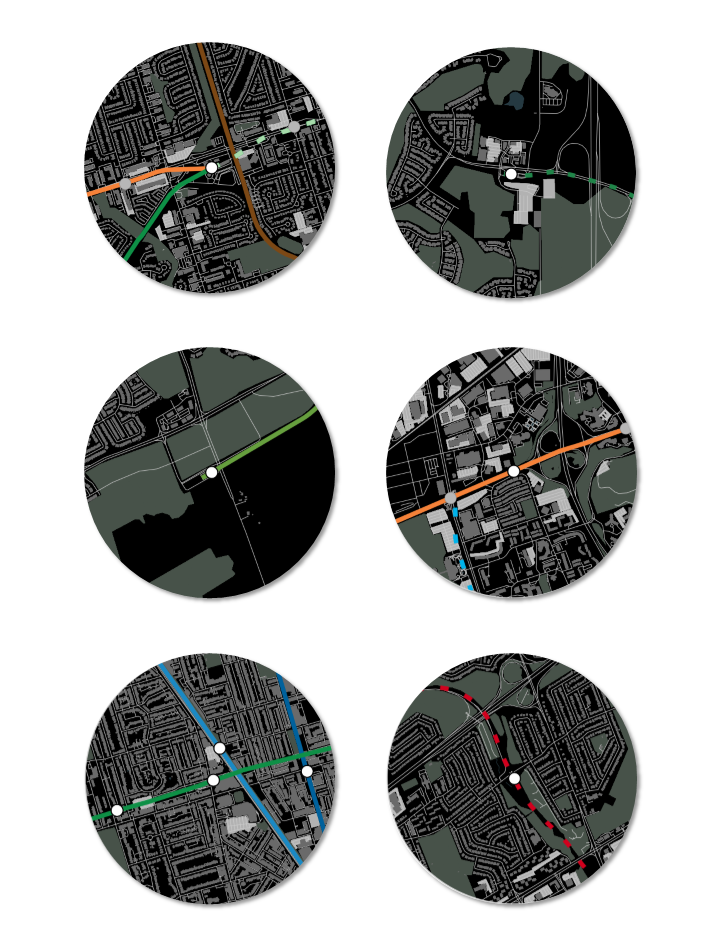
Urban form maps. The built form of a transit station influences its development potential.
Source: Urban Form Tool
Given that investments in transit projects do not all result in the same potential for housing development,
which transit stations do have the highest potential for housing and what do they have in common? Moreover, when new transit
stations are planned, where should they be placed to get the most return on housing?
This report examines land availability and
growth pressure in transit station areas to understand where capacity and demand for housing is greatest, assessing overall
potential for transit-oriented development across Canada’s higher-order transit stations.
Land Availability vs. Growth Pressure
NorQuest is an example of a station with low land availability and high growth pressure.
Source: Development Potential Tool
To examine the housing development potential of each station area, we selected five land availability and five growth pressure indicators to create a land availability and growth pressure score for each station.
These are the indicators:
Land Availability
- Developable Area (Total Area - Water - Greenspace)
- High Opportunity Area (Surface Parking Area)
- Single Unit Residences
- Population Density
- Employment Density
Growth Pressure
- Station Area Population Change, 2020-2025
- Station Area Population Change, 2025-2030
- Municipal Population Growth, 2020-2025
- Daily Visits
- Overall Complete Community Score
The land availability indicators were selected to reflect the station area’s capacity for new housing development. The growth pressure indicators were selected to reflect the station area's demand for new housing. The land availability and growth pressure scores are averages of the station’s percentile rank for each set of indicators. The station area refers to the 800m radius surrounding a station.
Land Availability and Growth Pressure are negatively correlated. Stations with high growth pressure generally have low land availability, and stations with high land availability generally have low growth pressure.
We can break the land availability vs. growth pressure scatterplot up based on the median for each, and categorize each station as low or high land availability and growth pressure. From there, we can examine a station’s development potential based on its overall demand and capacity for new housing.
Identifying housing development potential in transit station areas
Calgary
The most common scenario is low land availability and high growth pressure. There are 13 stations with high land availability and high growth pressure, including Chinook, Dalhousie, and Lions Park on the Red Line, and the planned Seton, 28 Avenue N, and 16 Avenue N stations on the Green Line.
Edmonton
The most common scenario is high land availability and low growth pressure. There are 3 stations with high land availability and high growth pressure: McKernan-Belgravia on the Capital Line, and NAIT/Blatchford Market and Kingsway RAH on the Metro line.
Greater Golden Horseshoe
The most common scenario is low land availability and high growth pressure. There are 86 stations with high land availability and high growth pressure, including Oakwood on Line 5 Eglinton, Main Street on Line 2 Bloor-Danforth, and Milton on the Milton Line.
Greater Vancouver/Lower Mainland
The most common scenario is low land availability and high growth pressure. Stations in Greater Vancouver/Lower Mainland have the lowest average land availability and highest average growth pressure of all regions. There are 6 stations with high land availability and high growth pressure, including the under construction Willowbrook, Hillcrest-184 St, and 152 St stations on the Expo Line.
Montreal
The most common scenario is high land availability and low growth pressure. There are 5 stations with high land availability and high growth pressure, including Ahuntsic on Ligne Mascouche, Préfontaine on Ligne Verte, and Montmorency on Ligne Orange.
Ottawa-Gatineau
The most common scenario is high land availability and low growth pressure. There are 2 stations with high land availability and high growth pressure: Tunney’s Pasture on Line 1 Trim-Algonquin and Line 3 Trim-Moodie, and Corso Italia on Line 2 Bayview-Limebank.
Ville de Québec
The most common scenario is high land availability and low growth pressure. There is 1 station with high land availability and high growth pressure: CHUL on the planned Quebec Tramway.
Development potential by technology
Patterns in land availability and growth pressure differ by technology.
Commuter
The most common scenario for commuter stations is high land availability and low growth pressure, indicating more land capacity for new housing, but less demand for it. These stations are frequently found in suburban or urban fringe communities, where population growth is slower, population density is lower, and the station area is less built up. Examples of commuter stations with high land availability and low growth pressure include East Gwillimbury GO station, Acton GO station, and Vaudreuil station.
Subway
In contrast, the most common scenario for subway stations is low land availability and high growth pressure, reflecting limited land capacity for new housing, but high demand for it. Subway stations like Bloor-Yonge station in Toronto, Granville station in Vancouver, and Berri-UQAM station in Montreal are located downtown, in areas that are densely populated, highly developed, and facing high growth pressure. Outside of downtowns, subway stations still frequently lie in older neighbourhoods where the station area has developed and built up over many years. As a result, subway stations such as Runnymede in Toronto, Langara-49th Avenue in Vancouver, and De Castelnau in Montreal, while not as centrally located, nevertheless have limited land capacity for new development.
LRT
Though the most common scenario for LRT stations is high land availability and low growth pressure, their distribution across land availability-growth pressure categories is relatively balanced compared to commuter and subway stations. Additionally, LRT is the most common technology for high land availability, high growth pressure stations, with over half of these high-high stations found on LRT lines. Many of these high-high stations are on relatively new LRT lines in suburban areas, for example Ionview station in Toronto, Borden station in Kitchener, and Kingsway/Royal Alex station in Edmonton.
Transit-oriented housing development looks different in different places.
Urban form maps. The built form of a transit station influences its development potential.
Source: Urban Form Tool
NorQuest is an example of a station with low land availability and high growth pressure.
Source: Development Potential Tool
Conclusion
When it comes to building new transit stations, areas that are high in demand and land capacity for new housing are ideal places to do so. Whether they are located in greenfields, commercial areas, or employment centres, areas with high growth pressure and high land availability present unique opportunities to create transit-oriented developments that serve their residents.
Our land availability and growth pressure scores are policy-independent measurements; they assess a station’s potential for housing development based on physical and land-use characteristics, rather than what is possible based on existing planning regulations. This policy-agnostic approach allows us to consider what may be possible if provinces and municipalities aligned policy to maximize home-building return on higher-order transit investments.
Alongside the development of new housing, station areas require additional infrastructure to become livable, accessible neighbourhoods. These additional amenities are essential to creating a high quality of life in station areas, bringing them from transit-oriented developments to transit-oriented complete communities.